
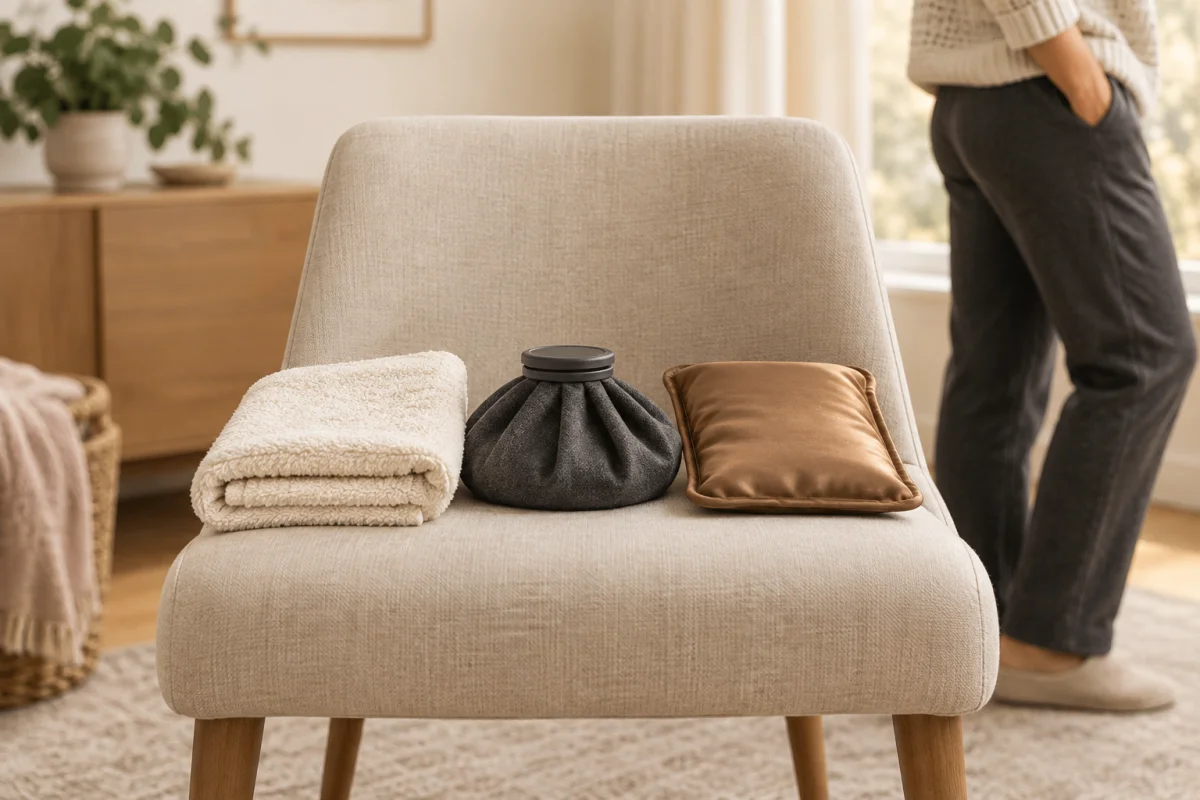
For a recent minor back strain, a wrapped cold pack is a reasonable first option; for tight or stiff muscles, gentle warmth may help. Both can offer temporary relief, but the supplied evidence does not establish a universal winner. MedlinePlus describes ice for the first 48–72 hours followed by heat as one approach—not a rule for every new backache. MedlinePlus
This comparison covers uncomplicated lower back discomfort. Significant injury, severe pain, or new neurological symptoms call for medical assessment rather than experimenting with heat and cold.
Heat versus ice at a glance
| Question | Cold pack | Gentle heat |
|---|---|---|
| What may it help with? | Temporarily numbing pain and reducing swelling | Easing stiffness and muscle spasm |
| When might you try it? | Soon after a minor strain or injury | When muscles feel tight or stiff, or after the initial injury period |
| How should you protect your skin? | Wrap the pack; never put ice directly on skin | Protect skin from the heating device and follow its instructions |
| What is its limitation? | Relief does not necessarily mean faster recovery | Relief does not necessarily mean faster recovery |
The symptom and skin-protection distinctions come from Johns Hopkins Medicine. The recovery limitation comes from the North American Spine Society’s back pain pamphlet.
When cold may be worth trying
If your lower back became sore after a minor strain, cold may help numb the discomfort. General injury guidance commonly favors cold early on: MedlinePlus suggests the first 48–72 hours, while Johns Hopkins advises avoiding heat during the first 48 hours after an injury. These are practical time frames, not an exact switch that applies to every episode of back pain. MedlinePlus · Johns Hopkins Medicine
For application:
- Wrap the cold pack in a towel rather than placing it directly on your skin.
- Keep each application to no more than 20 minutes.
- Stop if it causes discomfort or skin irritation.
The North American Spine Society supports a skin barrier and ice applications of up to 20 minutes. Longer or colder is not the goal.
When warmth may be worth trying
Gentle warmth may help when tightness or stiffness is your main complaint. Heat can reduce stiffness and muscle spasm, according to Johns Hopkins Medicine.
Advice to avoid heat early after an injury should not be interpreted as “every new backache must be iced.” The cited timing advice concerns injuries, rather than every possible cause of back discomfort. If the cause is unclear or symptoms are worsening, seek medical advice rather than relying only on how many hours have passed.
Protect your skin from the heating device and follow its instructions. Do not increase the temperature to chase stronger relief.
How to avoid burns and cold injuries
Both options require skin precautions. Never apply ice directly to bare skin, and protect your skin from heating devices. Johns Hopkins Medicine
If you have reduced sensation, circulation problems, or a skin condition affecting the area, ask a healthcare professional whether heat or cold is appropriate before trying it. UCSF specifically identifies poor circulation and Raynaud’s phenomenon as reasons to avoid cold therapy. It also advises against combining heat with topical menthol or medicated ointments. UCSF Pain Management Education
If an application makes your symptoms worse, stop. Do not continue an uncomfortable application simply because heat or cold is commonly recommended.
Does either option help your back heal faster?
Feeling better during or after an application is not the same as recovering faster. The North American Spine Society notes that heat and ice may temporarily reduce lower back pain but do not necessarily speed long-term recovery. Back pain basics
Temporary relief also does not identify the cause of pain or establish that an underlying problem has resolved. The patient-education sources used here do not establish either option as the best choice for everyone.
When to stop home treatment and get medical help
Do not let temporary relief delay assessment. Seek prompt medical help for lower back pain accompanied by:
- New bladder or bowel control changes.
- New weakness or numbness.
- Unexplained fever.
- Pain following a significant fall, collision, or other major trauma.
- Severe pain, especially if you cannot get comfortable.
These warning signs are described in MedlinePlus’s acute low back pain guidance. They should not be managed solely by switching between heat and ice or waiting for a routine self-care appointment.
What if the pain keeps returning?
If you repeatedly need heat or cold for the same discomfort, consider an assessment rather than increasing the temperature or length of applications. It may help to note when the pain began, whether there was an injury, which activities affect it, and whether heat or cold provided relief.
For readers considering local chiropractic care, Back & Neck Care Center of Bedford provides back pain care with Dr. Richard Chatfield. Visits are by appointment at 2803 Central Dr, Bedford, TX 76021. Call 817-283-6100 for appointment information.
The takeaway: Cold may be worth trying soon after a minor strain; gentle warmth may help tight or stiff muscles. Use either for short-term comfort, protect your skin, and do not use temporary relief to dismiss worsening or concerning symptoms.
Evidence note: This comparison uses US patient-education resources, not a head-to-head trial establishing a universal winner. Several sources have no verified update date, and the North American Spine Society pamphlet is older. Business details come from the supplied config.yaml and confirmed/verified facts.yaml references.